

BetUS

BetNow

MyBookie

Bet105

BUSR Sports

Everygame Sports

BetOnline

BetWhale

BetAnything

Xbet

Bovada

Bookmaker
Turn the scoreboard into a simple rulebook.
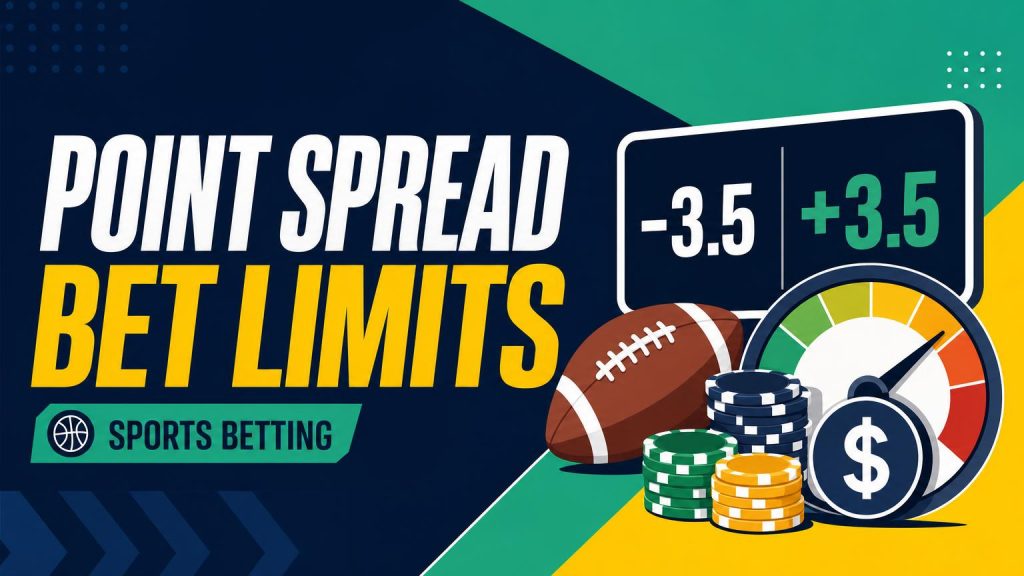
Seeing -3.5 next to a team feels like a secret code before kickoff. Beginners freeze at plus/minus signs, half-points, pushes and the juice (vig). This section breaks those terms down: minus = favorite must win by more than the spread; plus = underdog gets a head start; half-points prevent ties; juice slightly skews payouts toward the book. Clear examples and simple next steps will follow so placing a first spread bet feels straightforward.
- Typical pricing: -110 on each side (book margin ≈ 4–5%).
- Half-points are common; quarters are rare and used to eliminate pushes.
- Beginner next steps: watch one market, bet small, review the settlement.
What a point spread is
A point spread is a betting handicap applied to a game's final score so wagers on either side are roughly even — in one sentence: it adds or subtracts points from a team's score for settlement, not to change the actual game.
Read the notation like this: Team A -7.5 vs Team B +7.5 means Team A is the favorite by 7.5 points (7.5 points will be subtracted from Team A's final score for the bet). Team B is the underdog and gets 7.5 points added.
Top Sportsbook Picks for October 2026
BetUS
BetNow
MyBookie
Bet105
BUSR Sports
Everygame Sports
BetOnline
BetWhale
BetAnything
Xbet
Bovada
Bookmaker
Common settlement outcomes:
- If the favorite wins by more than the spread (margin > 7.5), bets on the favorite win.
- If the favorite wins by less than the spread or loses (margin < 7.5), bets on the underdog win.
- If the margin equals the spread exactly, the bet is a push (stake refunded); sportsbooks often use half-points to avoid pushes.
Remember: the spread is a handicap to balance betting, not an exact score prediction.
A half-point (e.g., -7.5) prevents pushes — check if a line has .5 to know whether ties are possible.
How sportsbooks set opening spreads — and why lines move
Sportsbooks start with power ratings and models: algorithms that weight team performance, home-field advantage, injuries, and situational factors to produce an initial handicap. That opening spread is a prediction plus a business decision — bookmakers also consider how to balance bets so they aren’t overly exposed to one outcome.
Lines move because of two forces: the bets themselves and new information. Public money (lots of small wagers) can shift a line slowly; sharp money (few large, professional wagers) often prompts quicker, larger moves as books respect informed action. Books may adjust a line to minimize liability rather than to reflect a changed prediction.
Common pregame movers
- Late injury or lineup news
- Weather changes or travel issues
- Big square-market bets from casual bettors
- Large smart-money tickets that indicate edges
Movement is normal and informative: a drifting line can highlight market sentiment, while a sudden jump often signals sharp activity. For a deeper look at specific causes and next steps, see the common causes explained.
Moneyline versus spread — and the vig
Moneyline vs spread
Moneyline bets pick the outright winner; the payout changes with how favored a team is (e.g., -150 pays less than +130). Point spread bets pick the margin of victory: a favorite at -7.5 must win by 8 or more; an underdog at +7.5 can lose by 7 and still cover.
How the vig (-110) affects payouts
Most spread lines use a -110 price on each side. That means a $110 stake wins $100 profit (total return $210) when correct. Implied probability for -110 is about 52.38%; two sides at -110 sum to roughly 104.76%, so the extra 4.76% is the sportsbook's margin (vig).
Example: a $110 bet at -110 → $100 profit. By contrast, moneyline odds vary: $100 on -150 returns $166.67 total ($66.67 profit); $100 on +130 returns $230 ($130 profit).
Pushes, ties and half-points
A push happens when the final margin equals the integer spread (e.g., -7); the stake is refunded. Adding a half-point (e.g., -7.5) removes the possibility of a push, forcing a win or loss. In multi-leg bets a pushed leg is usually voided, reducing the parlay to fewer legs.
When a line uses -110 on both sides, expect roughly the same payout for either outcome; half-point spreads change settlement, not the underlying team strength.
Worked examples: payout, pushes, and converting spreads into probabilities
- Compute payout for $100 at -110
Place a $100 wager on a -110 price. Profit = 100 × (100/110) ≈ $90.91, so the total return = $100 stake + $90.91 profit = $190.91 (round cents).
- Half-point line outcome (no push)
If the spread is -7.5 and the favorite wins by 8 or more, the bettor wins and receives the payout above; if the favorite wins by 7 or fewer, the bettor loses the $100 stake. A half-point removes the possibility of a push.
- Whole-point line and push treatment
With a -7 line, a 7-point victory results in a push: the original $100 stake is returned and no win/loss is recorded. If the bet had won, the -110 formula would determine profit; on a push the vig is not taken.
- Convert American odds (-110) to implied probability
For negative American odds, implied probability = |odds| / (|odds| + 100). For -110 that is 110/210 ≈ 52.38%, which reflects the market price including vig.
- Turn a point spread into a model probability
Use a normal approximation: P(favorite wins) ≈ Φ(spread / σ). Example: spread = 7.5, assume σ = 13 points, then Φ(7.5/13) ≈ Φ(0.577) ≈ 0.72, so about 72% chance. For a fuller method to convert a spread into an implied win probability for modeling, consult the dedicated guide.
Common handicap variants and how they settle
Two variants appear frequently: Asian handicaps, which eliminate the simple draw outcome, and quarter-point splits that split a stake between nearby lines. For a broader comparison of these approaches, see differences between Asian and traditional spreads.
Asian handicap examples:
- -1: favorite must win by 2+ to win the bet; a 1-goal win is a push (stake returned); draw or loss loses.
- -1.5: favorite must win by 2+; a 1-goal win counts as a loss (no push).
Quarter-point (.25/.75) examples — stakes are split into halves (0 and 0.5 or n and n.5):
- Backing +0.25: if team draws, half the stake on 0 is returned, half on +0.5 wins (net half-win).
- Backing -0.25: if team draws, half is returned, half loses (net half-loss). For more on this, read how +0.25 bets settle.
Quick spotting tip: decimals of .5 mean no pushes; .0 whole numbers can push; .25/.75 indicate split settlements.
Alternative point spreads
Alternative point spreads let a bettor buy or sell points off the main market at an adjusted price. Each full or half‑point moved changes the bookmaker’s implied probability, so the posted odds (the price) will normally become less favorable as the line moves toward a bettor’s preferred outcome.
When to consider an alternative line:
- To buy points and avoid a push (e.g., move -3 to -2.5) when the extra half‑point is worth the worse price.
- To sell points for bigger payouts if confident a bigger margin will occur.
- To create a middle or hedge exposures after line moves.
Quick rule: compare the new implied probability to a bettor’s edge and only take the alternative when expected value improves. For a numeric breakdown, consult the detailed explainer on point-by-point odds shifts.
Finding value: closing-line edge and buying half-points
Practical steps to spot +EV situations
Closing-line value (CLV) is the simplest long-run test of an edge: if a bettor’s wagers routinely have better lines than the market close, the bettor probably has positive expectation. Track the line at bet time and compare it to the closing number after the market settles; consistent wins versus the close matter more than any single ticket. For mechanics and measurement, see how to measure if a bet beat the market.
A short decision framework for buying a half-point:
- Cost: moving from -110 to -115 (example) increases the break-even probability; the vig makes the half-point non‑free. Estimate the implied probability change from the point move.
- Benefit: a half-point often converts pushes into wins or losses into pushes; quantify how much that outcome change improves expected value.
- Rule of thumb: buy a half-point when the expected probability gain from the point exceeds the cost implied by worse odds.
Quick tips:
- Record bet-time lines and sizes.
- Only buy points when they change settlement (push→win) or when the math clearly favors the cost.
- Stay disciplined: small edges matter only with consistent tracking.
Common questions about CLV and half-points
What exactly is closing-line value?
Closing-line value is the difference between the line taken and the final market line; consistently having a better line than the close suggests a statistical edge over time.
How should lines be recorded for CLV tracking?
Record the exact number and time of every bet, then compare with the published closing line after markets lock. Use spreadsheets or tracking apps to compute win rates versus the close.
When is buying a half-point most useful?
Buying a half-point is most valuable when it turns a push into a win (or loss into push) or when the implied probability gain exceeds the worse payout; small behavioral advantages aren’t enough alone.
Where to read deeper analysis on whether buying half-points pays?
For a more detailed cost–benefit discussion and examples, consult the detailed cost–benefit analysis on buying half-points.
Five-step betting checklist
- Confirm spread and vig
Write down the exact line (e.g., -7.5) and the price (e.g., -110) before placing a bet.
- Identify roles and context
Note which team is favorite or underdog and any roster, weather, or situational factors affecting the handicap.
- Check market movement
Compare opening, current, and expected closing lines to spot sharp action or public bias.
- Decide whether to buy points
Weigh the cost of buying half/full points against the probability shift and potential middles.
- Stake responsibly and log results
Set a stake size, place the wager, and record the line, stake, and outcome for future analysis.
Mini-glossary of core terms
Spread
A handicap set by the sportsbook (negative for favorites, positive for underdogs) that determines winning margin.
Favorite / Underdog
Favorite = team expected to win (minus spread); underdog = team given points (plus spread).
Juice
The sportsbook's commission or vig (commonly reflected as -110), which reduces net payout.
Push
A tie between the final margin and the spread; stakes are returned and the bet voids.
CLV
Closing-line value — consistently beating the closing spread indicates a likely long-term edge.
Next steps and takeaways
- Begin with small stakes and simple bets to learn line behavior.
- Track every bet and compare to closing lines to measure CLV.
- Review bought points and middles to refine when purchases make sense.
Practical start: begin small, log bets, and focus on closing-line value as the primary signal of edge. Practice reading line moves and evaluating buys; let data, not hunches, guide adjustments.
Top Sportsbook Picks for October 2026
BetUS
BetNow
MyBookie
Bet105
BUSR Sports
Everygame Sports
BetOnline
BetWhale
BetAnything
Xbet
Bovada