

BetUS

BetNow

MyBookie

Bet105

BUSR Sports

Everygame Sports

BetOnline

BetWhale

BetAnything

Xbet

Bovada

Bookmaker
A winning strategy can still be staked into disaster.
Six straight even-money losses turn a $1,000 bankroll into about $735, $531, or $262 when each wager risks 5%, 10%, or 20% of the current balance. For a bettor expected to win 55% of independent bets, that streak is uncomfortable but hardly unthinkable over a long run.
The edge makes each bet profitable on average; it does not smooth the journey. Larger stakes amplify growth during favorable runs, but they also deepen routine drawdowns and leave less capital available for recovery. With proportional staking, the balance may never reach literal zero, so “ruin” usually means falling below a practical threshold. The chosen stake can therefore matter as much as the estimated win rate.
Ruin does not have to mean zero
In bankroll calculations, ruin is a chosen lower boundary, not necessarily an empty account. A bettor with $5,000 might set ruin at $1,500 because falling below that level would make the strategy impractical, force smaller stakes, or trigger a planned stop. This practical definition fits within broader bankroll management for beginners.
The time horizon also matters. Eventual ruin asks whether the bankroll will ever touch the floor if play continues indefinitely. A finite-horizon calculation instead asks whether that floor might be reached during 500 bets, within one season, or before the bankroll reaches a target such as $7,500.
Top Sportsbook Picks for October 2026
BetUS
BetNow
MyBookie
Bet105
BUSR Sports
Everygame Sports
BetOnline
BetWhale
BetAnything
Xbet
Bovada
Bookmaker
Those questions can produce very different probabilities, so any result should state:
- the starting bankroll and ruin floor;
- stake size, expected edge, and outcome variance;
- the number of bets or profit target, if either applies.
Risk of ruin is therefore a planning estimate, not a forecast of what will happen. It helps compare staking choices and decide whether a downside level is tolerable under a stated set of assumptions.
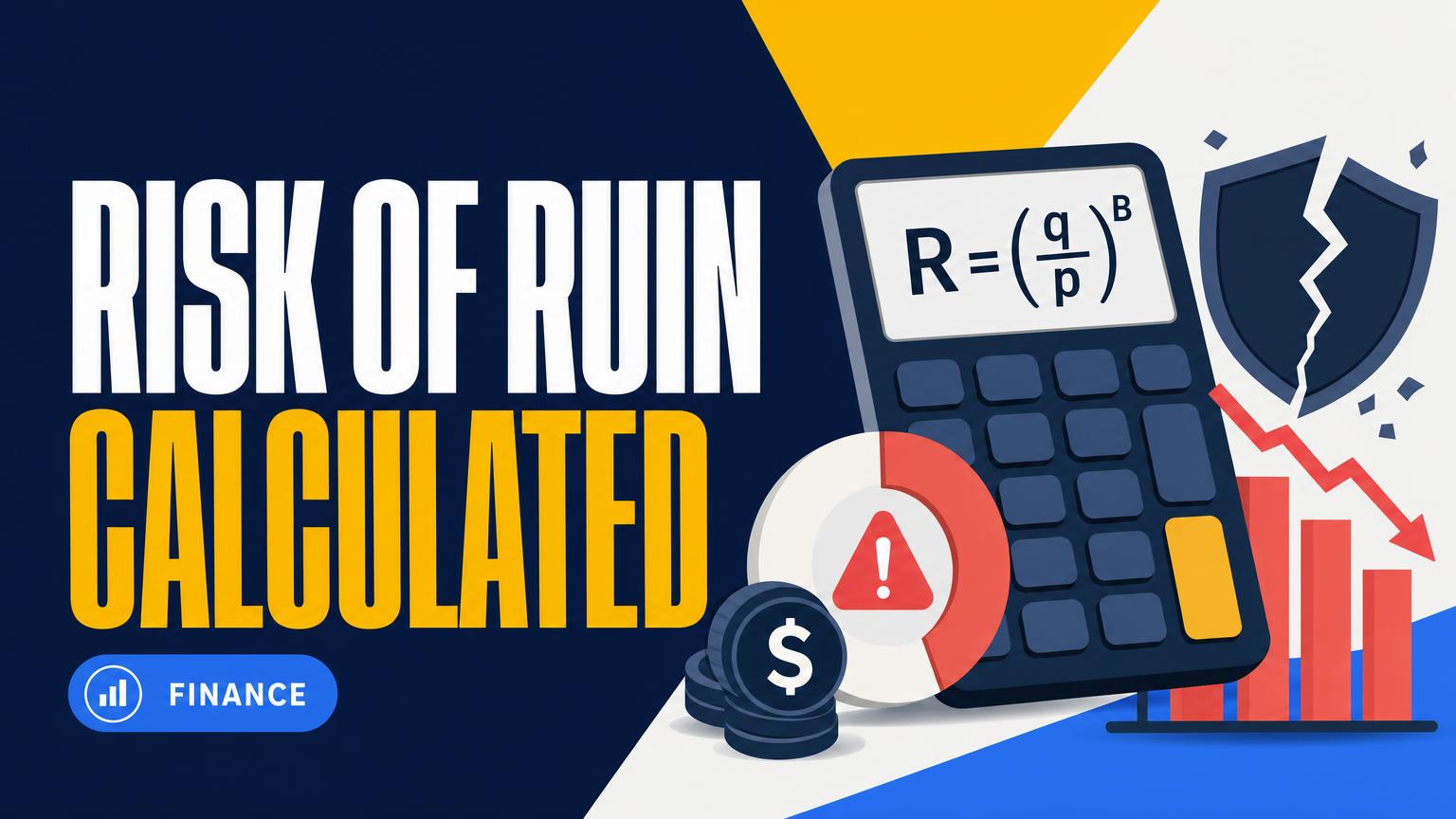
The classic risk of ruin formula
For a bankroll measured in betting units, the classic infinite-horizon formula is:
$$R=\left(\frac{q}{p}\right)^B$$
Here, R is the probability of eventually reaching the ruin boundary, p is the probability of winning a bet, q = 1-p is the probability of losing, and B is the number of units available above that boundary.
Suppose a bettor has 10 units, wins 55% of bets, and loses 45%. The estimated chance of eventual ruin is:
$$R=\left(\frac{0.45}{0.55}\right)^{10}\approx13.4\%$$
The equation applies only when bets are independent, probabilities remain constant, and every wager risks one fixed unit to win one fixed unit. It also assumes play can continue indefinitely, with no changing stakes, fees, ties, withdrawals, or betting limits.
Crucially, this version requires p > q. If the game is fair or unfavorable—meaning $p \le q$—the probability of eventual ruin approaches 100% under unlimited repeated play. A fair game may wander upward for long periods, but without a positive drift it will eventually revisit the lower boundary. A negative edge makes that outcome still more likely.
Even with $p>q$, the result is not genuinely zero for any finite bankroll when losses remain possible. More capital or a stronger edge can make ruin extremely unlikely, but ordinary betting cannot eliminate it. A true zero would require no exposure, no possible losing outcome, or assumptions that no longer describe real wagering.
- R
The probability of eventually reaching the chosen ruin boundary.
- p
The fixed probability of winning one bet.
- q
The fixed probability of losing one bet, equal to 1 − p in a two-outcome model.
- B
The bankroll measured in fixed betting units above the ruin boundary.
- Positive edge
The condition p > q, required for this formula to produce a ruin probability below 100%.
Ruin before a bankroll target
The finite-target model asks a precise question: starting with a bankroll of (i) betting units, what is the probability of reaching zero before reaching (N) units? Play stops when either boundary is hit. This differs from lifetime ruin, because a successful run ends at the upper target rather than continuing indefinitely.
Let (p) be the probability of winning each equal-payoff bet and (q=1-p) the probability of losing. For (p \ne q), the probability of hitting zero first is:
[ P(\text{ruin before }N)=\frac{(q/p)^i-(q/p)^N}{1-(q/p)^N} ]
For a fair bet, where (p=q=0.5), the expression simplifies to:
[ P(\text{ruin before }N)=\frac{N-i}{N}=1-\frac{i}{N} ]
Suppose a player starts with 20 units, stops after either losing everything or reaching 40 units, and wins each bet with probability 0.55. Substituting (p=0.55), (q=0.45), (i=20), and (N=40) gives a ruin probability of about 1.8%. With a fair bet, the same starting bankroll and target produce a 50% probability.
The target must always accompany the result. “A 1.8% risk of ruin” is incomplete without “before reaching 40 units.” If play instead stops after a fixed number of bets, a separate finite-horizon calculation is required.
A small edge estimate changes everything
For an even-money bettor risking one fixed unit per wager, let the bankroll contain 20 units. With a 55% win probability, the loss probability is 45%, so the classic infinite-horizon calculation is:
[ P(\text{ruin})=\left(\frac{q}{p}\right)^B =\left(\frac{0.45}{0.55}\right)^{20} \approx 0.0181 ]
That produces an eventual ruin probability of about 1.8%. Under the model’s assumptions, the positive edge makes a 20-unit bankroll appear fairly resilient—though ruin remains possible.
Now reduce the estimated win rate from 55% to 52%:
[ P(\text{ruin})=\left(\frac{0.48}{0.52}\right)^{20} \approx 0.2018 ]
The result jumps to roughly 20.2%, more than eleven times the earlier estimate. A seemingly modest three-percentage-point change therefore transforms the same bankroll from relatively comfortable to seriously vulnerable.
| Estimated win rate | Estimated edge | Eventual ruin risk |
|---|---|---|
| 55% | 10% return per even-money bet | 1.8% |
| 52% | 4% return per even-money bet | 20.2% |
This sensitivity makes the input estimate more important than the arithmetic. A short winning record can easily make a 52% bettor look like a 55% bettor—or the reverse. Before treating either figure as dependable, the sample size needed to support an apparent edge should be examined, along with changing conditions and selection bias. The formula is precise only when its assumptions and estimated probabilities are credible.
When wins and losses are unequal
American odds of -110 mean risking 1 unit to earn only about 0.909 units. A loss still removes the full unit. The classic equal-payoff formula therefore cannot use the quoted win probability without adjustment; the payoff distribution itself matters.
For one fixed-stake bet, define the net return as (X):
- Win: (X=+0.909), with probability (p)
- Loss: (X=-1), with probability (1-p)
The expected return per bet is
[ \mu=0.909p-(1-p), ]
and the return variance is
[ \sigma^2=p(0.909-\mu)^2+(1-p)(-1-\mu)^2. ]
If (B) is the bankroll measured in fixed-stake units above the ruin floor, a common infinite-horizon approximation is
[ P(\text{ruin})\approx e^{-2\mu B/\sigma^2}, \qquad \mu>0. ]
At a 55% win rate, (\mu\approx0.050) and (\sigma^2\approx0.902). With 20 bankroll units, the approximation gives roughly 10.9% ruin risk.
This is a diffusion-style estimate, not an exact sportsbook formula. It works best for many independent, identically distributed bets with a small edge and a truly fixed stake. Discrete bankroll steps, changing odds, correlated wagers, stake resizing, finite targets, and bet limits can produce materially different results.
At -110, the break-even win rate is about 52.38%. If the estimated rate does not exceed that threshold, (\mu\leq0), so the favorable exponential approximation is not applicable; over an unlimited horizon, eventual ruin becomes the central concern.
Where ruin estimates become misleading
Exposure can be correlated across games, markets, or parlay legs.
Shared teams, weather, injuries, and market moves can make losses arrive together. Parlays create explicit dependence. Group related positions or model them jointly rather than treating every bet as a fresh coin flip.
Odds, pushes, limits, edges, and bet sizes change over time.
A fixed-unit formula misses reduced limits, skipped bets, withdrawals, and bankroll-based staking. Even a genuine edge may weaken as prices move or conditions change.
The meaningful boundary is often a practical bankroll floor.
A bettor may stop when stakes become ineffective, limits prevent execution, or further losses become psychologically unacceptable. A drawdown above that floor is painful but recoverable; crossing it is operational ruin.
Estimated win rates contain sampling error, while future payouts and correlations remain uncertain. Better protection against deep drawdowns comes from testing several plausible cases—not trusting one percentage.
Stress tests should include a weaker edge, clustered losses, lower limits, pushes, withdrawals, and a higher practical ruin floor.
Simulating bankroll paths when formulas fall short
- Model each bet
For every wager, record or sample the win probability, price, and stake. Historical records can preserve changing odds and bet sizes; projected bets can draw them from realistic ranges.
- Set boundaries and horizon
Choose the starting bankroll, ruin floor, and number of bets. A longer horizon usually exposes more opportunities for damaging runs.
- Generate thousands of paths
Randomly resolve each wager, update the bankroll, and stop a path when it crosses the floor. Correlated outcomes can be modeled by grouping bets exposed to the same event or market.
- Count floor breaches
Estimated ruin probability equals breached paths divided by total paths. Ten thousand paths provide a useful first pass, though rare outcomes may require far more.
- Compare staking rules
Run identical assumptions with fixed-unit stakes and Kelly-based bankroll sizing. Fractional Kelly often offers a more practical comparison than full Kelly because edge estimates are uncertain.
Repeat the simulation with a weaker edge, worse prices, clustered losses, and a longer betting horizon. A plan that looks safe only under the best estimate is fragile; the conservative runs are often more informative than the headline result.
- Define the ruin floor
Choose the bankroll level at which play must stop, rather than assuming ruin means zero.
- Express stakes in units
Record each wager as a percentage of current bankroll so different staking plans remain comparable.
- Use conservative assumptions
Reduce the estimated edge and allow for realistic odds, fees, limits, and correlated results.
- Test several stake sizes
Compare plausible inputs. Smaller stakes generally lower ruin risk, though they also slow bankroll growth.
- Recalculate when conditions change
Update the range after shifts in bankroll, odds, strategy, bet size, or estimated win rate.
Treat ruin as a range, not a promise
A ruin estimate supports repeatable staking only when its floor and assumptions are explicit. Sensitivity testing is usually more informative than a single percentage.
A daily stop loss may limit one session’s damage, but it cannot turn a negative edge positive. Long-term survival still depends on sound assumptions and sufficiently small stakes.
Top Sportsbook Picks for October 2026
BetUS
BetNow
MyBookie
Bet105
BUSR Sports
Everygame Sports
BetOnline
BetWhale
BetAnything
Xbet
Bovada