

Bovada

BetUS

BetNow

MyBookie

Bet105

BUSR Sports

Everygame Sports

BetOnline

BetWhale

BetAnything

Xbet

Bookmaker
The bookmaker’s margin hides in the gap between the odds and the outcome.
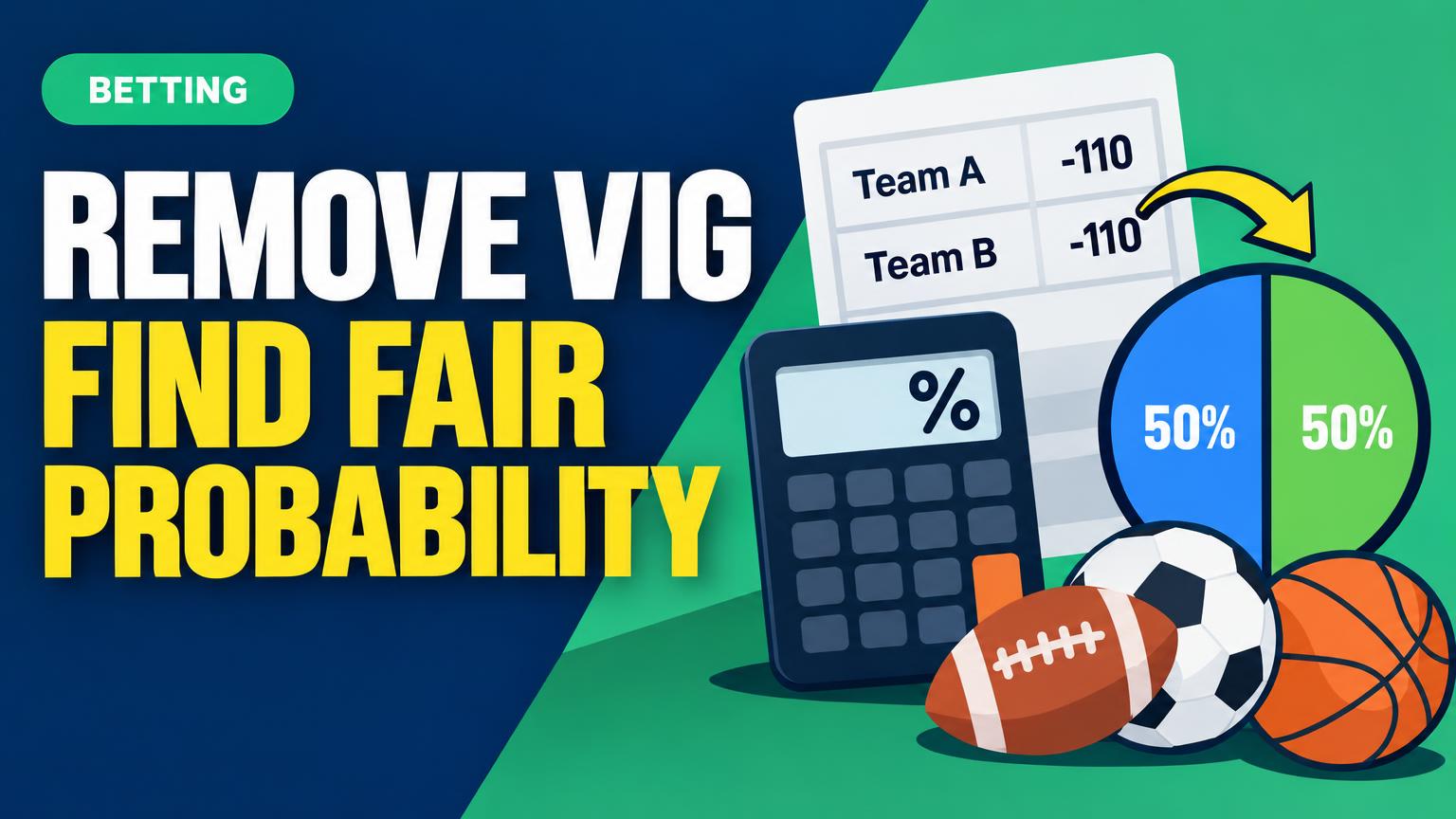
A bettor opens a two-sided market and sees −110 on both outcomes. Each price implies a 52.38% chance, so the two implied probabilities add up to 104.76%. The outcomes cannot both carry those probabilities in a market where exactly one must win; the extra 4.76 percentage points reflect the bookmaker’s built-in margin, often called vig.
A simple way to remove it is to divide each implied probability by their combined total: 52.38 ÷ 104.76 = 50% per side. That produces a no-vig estimate, not proof that each outcome truly has a 50% chance. It assumes the margin is spread proportionally across the posted prices; the bookmaker may not have priced both sides equally accurately.
Collect every outcome from one market
Before removing vig, collect the odds for every possible outcome in a single market from one sportsbook. A two-way tennis match might list only Player A and Player B. A three-way soccer market needs home win, draw, and away win; leaving out the draw makes the probability total unusable.
Record the prices at roughly the same time. Odds can change, especially during live play, so a home price copied before a goal may not belong with a draw price copied afterward. Check that every selection follows the same settlement rules, too: “90-minute result” and “to advance” are different markets, even when they feature the same teams.
Top Crypto Sportsbooks for November 2026
BetUS
BetNow
MyBookie
Xbet
Keeping the outcomes together makes the later calculation a comparison of like with like. Comparing sportsbooks is a separate exercise: looking for better odds at multiple sportsbooks can reveal different prices, but a mixed set does not represent one book’s margin.
Convert American odds to implied probability
American odds use two different formulas depending on the sign. A negative number describes the amount staked to win 100 units; a positive number describes the amount won from a 100-unit stake. That convention is part of the broader relationship between odds, probabilities, and payouts.
- Negative odds: Implied probability = absolute value of odds ÷ (absolute value of odds + 100).
- Positive odds: Implied probability = 100 ÷ (odds + 100).
For the running two-outcome market, −150 converts to 150 ÷ (150 + 100) = 150 ÷ 250 = 60.00%. The other side, +130, converts to 100 ÷ (130 + 100) = 100 ÷ 230 ≈ 43.48%. Multiplying a decimal result by 100 expresses it as a percentage; rounding to two decimal places makes the figures easier to compare.
These are implied probabilities from the posted prices, not fair probabilities with the vig removed. Keep the unrounded results when doing the next calculation, then round the final estimates for display. Otherwise, small rounding differences can carry through to the adjusted probabilities.
Add the implied probabilities
Once every outcome has been converted, add the implied probabilities. For a separate illustrative two-outcome quote, suppose they are 52.38% and 51.10%:
52.38% + 51.10% = 103.48%
The total is 3.48 percentage points above 100%. That excess is the quoted market’s overround: a measure of how much the displayed odds collectively exceed a complete probability distribution. It is also a useful starting point for estimating fair probabilities, which must add up to 100%.
The overround makes it possible to compare vig across sportsbooks for the same market. For example, the earlier −110/−110 quote totals 104.76%, so its quoted overround is higher than this example’s. Such comparisons work best when the markets have the same outcomes and settlement rules; a two-way market and a three-way market are not interchangeable.
Overround is not guaranteed sportsbook profit. It describes the prices on offer, not the eventual result. Actual returns depend on which bets are placed, how much is staked on each outcome, and how the event settles.
Normalize the probabilities to remove the vig
With implied probabilities of 60.00% and 43.48%, the market total is 103.48%. Proportional normalization scales both outcomes by the same amount: divide each implied probability by the total, expressed as 103.48%. This preserves their relative sizes while bringing the combined probability down to 100%.
- First outcome: 60.00% ÷ 103.48% ≈ 57.98%
- Second outcome: 43.48% ÷ 103.48% ≈ 42.02%
- Check: 57.98% + 42.02% = 100.00%
The resulting figures are fair-probability estimates under this method, not a guarantee of either outcome’s true chance. The rounding shown here leaves the check at exactly 100%; with other odds, rounding each result to two decimal places may leave a small difference.
The 3.48 percentage-point overround belongs to the market total, not to each outcome separately. Subtracting 3.48 points from both quoted probabilities would give 56.52% and 40.00%, totaling just 96.52%. Even splitting the overround equally—subtracting 1.74 points from each—would produce different estimates: 58.26% and 41.74%. Proportional normalization instead reduces the 60.00% side by about 2.02 points and the 43.48% side by about 1.46 points.
Convert fair probabilities back to American odds
The normalized probabilities are enough to compare the two sides, but American odds may be easier to read alongside a sportsbook’s lines. Use each probability as a decimal—57.98% becomes 0.5798—then choose the formula based on whether it is above or below 0.50:
- Above 0.50: American odds = −100 × p ÷ (1 − p)
- Below 0.50: American odds = +100 × (1 − p) ÷ p
Here, p is the normalized probability for that outcome, not its original implied probability. At exactly 0.50, the equivalent is +100 (even money); the negative formula gives −100, another way to express the same return.
For the earlier example, 0.5798 converts to about −138, while 0.4202 converts to about +138. The two figures are symmetrical because the adjusted probabilities add to 1. Small differences in the final odds can arise if the probabilities were rounded before conversion, so retaining extra decimal places during calculation helps.
These are estimated no-vig odds, not necessarily prices available to place a bet. They show what the market’s quoted probabilities look like after proportional removal of the overround; a sportsbook may still post different odds.
Understand what the fair estimate can—and cannot—show
Proportional normalization divides each outcome’s implied probability by the market total. That makes the results add to 100%, but it also assumes the bookmaker’s margin is spread proportionally across the outcomes. If more margin is built into one side than another, a different removal method can produce a different fair-probability estimate.
Small discrepancies can come from the odds themselves. American odds are usually displayed as whole numbers, so converting them to probabilities cannot recover every decimal place behind a quote. Market rules matter too: a two-way market where a draw voids the bet is not the same as a three-way market where a draw is an outcome. The calculation is only as meaningful as the set of outcomes and settlement terms entered.
A normalized probability describes what the quoted market suggests after one method of removing its margin. It is not an independent prediction that an outcome will occur. For example, a 50% no-vig estimate from a −110/−110 market shows how that market balances after normalization; it does not establish that both sides truly have equal chances.
Expected-value calculations require a separate probability estimate and the actual odds offered for the bet. The expected-value calculation using an independent estimate addresses that comparison; the no-vig figure can serve as a market reference point, not a substitute for the independent estimate.
A no-vig probability is derived from prices. An independent probability estimate comes from an assessment of the event. Agreement between them does not prove either is accurate.
Check the fair-probability calculation
- Keep the market together
Use every outcome from the same market and set of prices. A three-way market needs the draw as well as both sides.
- Convert each price
Turn every quoted odd into an implied probability using the appropriate formula for its odds format.
- Add the probabilities
The total is the divisor for the next step. If it is 100% or less, recheck the prices, missing outcomes, and settlement rules before interpreting the result.
- Divide and check the sum
Divide each implied probability by the total, then add the adjusted figures. For example, 52% and 51% total 103%; dividing each by 103% gives about 50.49% and 49.51%, which sum to 100%.
A slight difference from 100% can result from rounding.
The check is whether the adjusted outcomes add to about 100%. Passing it confirms the arithmetic, not the accuracy of the underlying market or its settlement assumptions. The resulting figures are market-based estimates, not predictions or betting recommendations.
Top Crypto Sportsbooks for November 2026
BetUS
BetNow
MyBookie