

BetUS

BetNow

MyBookie

Bet105

BUSR Sports

Everygame Sports

BetOnline

BetWhale

BetAnything

Xbet

Bovada

Bookmaker
A quoted payout hides the chance behind it.
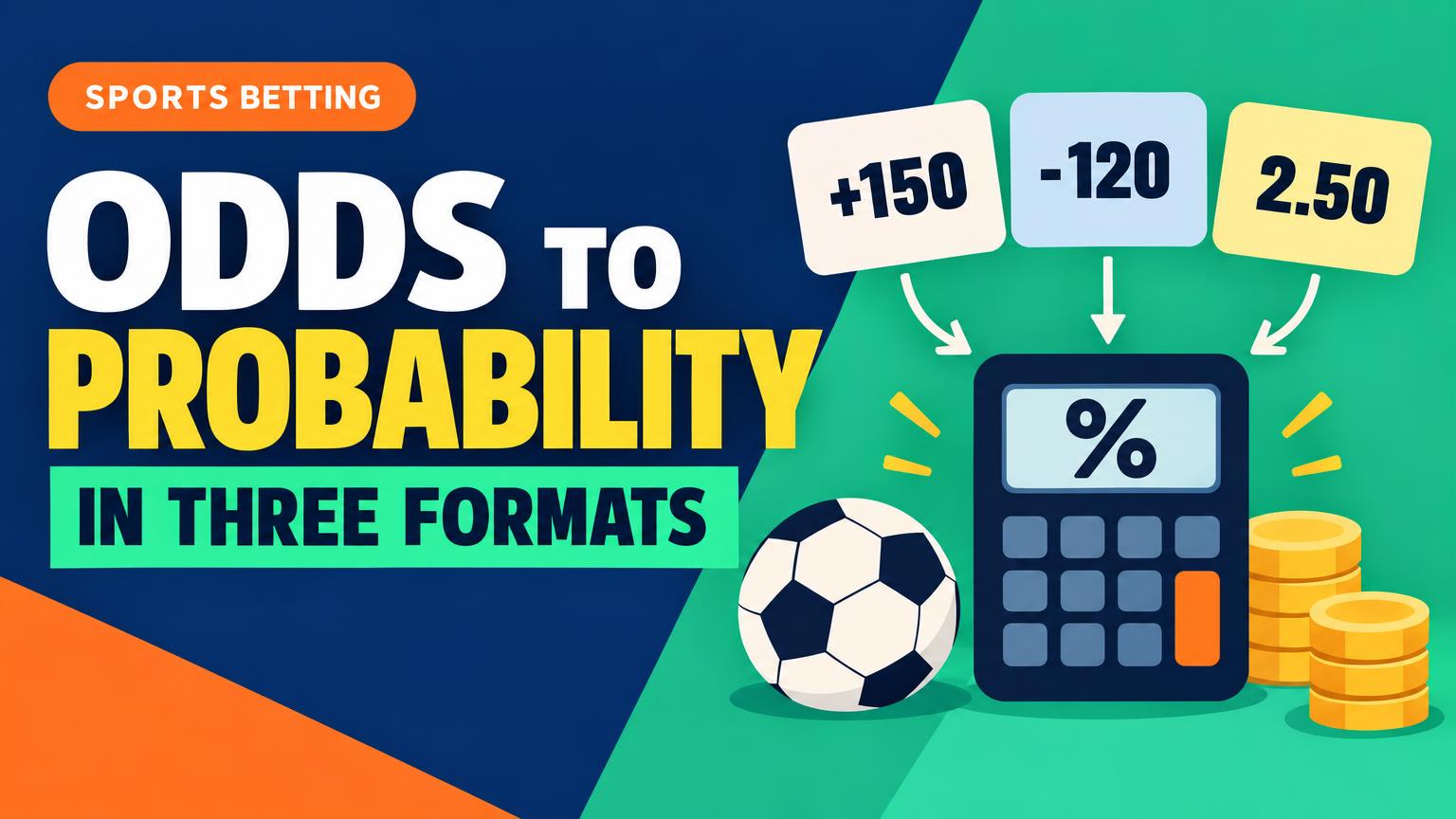
A match might be listed at 2.50 on one screen, 3/2 on another, and +150 on a third. The figures look unrelated, but each represents a 40% implied probability: 1 ÷ 2.50, 2 ÷ (3 + 2), and 100 ÷ (150 + 100) all equal 0.40.
That percentage makes differently formatted quotes comparable. It is not a guarantee that the event will happen four times in ten, though: it describes the chance implied by the quoted odds. Bookmakers may also include a margin, which can make the implied probabilities for all possible outcomes add up to more than 100%.
Identify the odds format
- Implied probability
The chance represented by a quoted price, expressed as a percentage. It is a way to interpret odds, not a prediction that an outcome will occur; how sports betting odds work provides more context on the quoted price.
- Decimal odds
A single number such as 1.80 shows the total return for each unit staked, including the original stake.
- Fractional odds
A ratio such as 4/5 shows potential profit relative to the stake: four units of profit for every five units staked.
- American odds
A plus sign shows potential profit on a 100-unit stake; a minus sign shows the stake needed for 100 units of profit. The sign determines which conversion formula applies.
Calculate probability from decimal odds
Decimal odds can be converted with one division: implied probability = (1 ÷ decimal odds) × 100. The quoted decimal price goes directly in the denominator. For odds of 2.50, the full calculation is (1 ÷ 2.50) × 100 = 0.40 × 100 = 40%.
The first result, 0.40, is a probability expressed as a decimal. Multiplying by 100 turns it into a percentage. Because decimal odds already include the returned stake, there is no need to add 1 to the quote before dividing.
Top Crypto Sportsbooks for November 2026
BetUS
BetNow
MyBookie
Xbet
The relationship runs in reverse: a lower decimal price implies a higher probability. For example, odds of 2.00 give (1 ÷ 2.00) × 100 = 50%, while odds of 4.00 give 25%. The calculation describes the probability implied by the quoted odds, not a guarantee that the outcome will occur.
Calculate probability from fractional odds
Fractional odds are written as A/B, where A is the potential profit and B is the stake. At 3/2, a stake of 2 units would return 3 units in profit if the outcome wins, plus the original 2-unit stake. The fraction describes that profit-to-stake relationship; it does not mean the outcome has a 3-in-2 chance of happening.
To convert fractional odds to implied probability, use:
Implied probability = B ÷ (A + B) × 100
For 3/2, A is 3 and B is 2. Substituting those numbers gives 2 ÷ (3 + 2) × 100 = 2 ÷ 5 × 100 = 40%. The denominator includes both the profit and the returned stake, which is why it is 5 rather than 3.
As a quick check, 1/1 produces 1 ÷ (1 + 1) × 100, or 50%. Fractional odds above 1/1 produce a lower implied probability; fractions below 1/1 produce a higher one.
Calculate probability from American odds
American odds need two formulas because the plus or minus sign changes what the number represents. For positive odds, such as +150, the number shows the potential profit on a 100-unit stake. For negative odds, such as −150, it shows the stake needed to make 100 units of profit. The stake units help explain the quote; no actual wager is needed for the calculation.
Positive odds: +X
For a positive quote, use 100 ÷ (X + 100) × 100, where X is the number after the plus sign. At +150, the calculation is 100 ÷ (150 + 100) × 100 = 40%. In other words, +150 corresponds to an implied probability of 40% before considering how the bookmaker’s margin affects a set of odds.
Negative odds: −X
For a negative quote, use X ÷ (X + 100) × 100, where X is the number after the minus sign, treated as a positive value. At −150, the calculation is 150 ÷ (150 + 100) × 100 = 60%. Using −150 in place of X would give the wrong result; the minus sign selects the formula, but it does not go into the arithmetic.
At −110, the same method gives 110 ÷ (110 + 100) × 100 = approximately 52.38%. That figure also appears when finding the win rate needed to break even at −110. Here, it describes the probability implied by the quoted odds, not a prediction of how often an outcome will occur.
Compare equivalent odds and check the result
Different formats can describe the same payout. Decimal 2.50, fractional 3/2, and American +150 all imply a 40% probability:
| Format | Calculation | Implied probability |
|---|---|---|
| Decimal 2.50 | 1 ÷ 2.50 | 40% |
| Fractional 3/2 | 2 ÷ (3 + 2) | 40% |
| American +150 | 100 ÷ (150 + 100) | 40% |
A useful sense check is to compare the answer with even odds: decimal 2.00, fractional 1/1, and American +100 each imply 50%. Odds shorter than even should produce a probability above 50%; longer odds should produce one below 50%.
- Shorter odds: Decimal 1.50, fractional 1/2, and American −200 each imply about 66.7%. For −200, the absolute value 200 goes in the numerator.
- Longer odds: Decimal 4.00, fractional 3/1, and American +300 each imply 25%. For +300, the numerator is 100, not 300.
If equivalent quotes give different answers, check whether fractional profit was confused with total payout. Decimal odds include the stake in the return; fractional odds describe profit alone.
Account for the bookmaker’s margin
An implied probability translates a quoted price into a percentage. It is not an independent estimate of the outcome’s true chance. To see the difference, consider a two-outcome market with both sides quoted at −110:
- Side A: 110 ÷ (110 + 100) = 52.38%
- Side B: 110 ÷ (110 + 100) = 52.38%
- Combined: 104.76%
The 4.76 percentage points above 100% are commonly called the bookmaker’s margin, or overround. The total describes the prices offered; it does not mean both opposing outcomes can each occur more than half the time. Nor is the excess a guaranteed profit on every bet.
To measure the bookmaker’s margin in another market, convert each listed outcome and add the implied probabilities. First check that the outcomes cover all possible results without overlap. A market with a draw needs a third price in the calculation, while a push or void can affect how a bet settles.
Dividing each 52.38% by the combined 104.76% gives 50% per side. This proportional adjustment removes the margin from this symmetric example, but it does not establish either side’s true chance. Prices may also reflect demand or changing information.
- Decimal odds Implied probability = (1 ÷ decimal odds) × 100. At 2.50, the result is 40%.
- Fractional odds For fractional odds A/B: implied probability = B ÷ (A + B) × 100. At 3/2, the result is 40%.
- American odds For positive odds +A: 100 ÷ (A + 100) × 100. For negative odds −A, where A is the positive number: A ÷ (A + 100) × 100.
- Quick check Even odds imply 50%. A shorter quote should produce a higher percentage; a longer quote should produce a lower one.
What the percentage does—and does not—show
Start by identifying the odds format, apply its formula, then compare the result with an easy benchmark such as even odds. If outcomes in the same market add up to more than 100%, bookmaker margin may explain the excess.
Implied probability translates a quote into a comparable percentage, not a reliable forecast on its own. To use probabilities to assess expected value, that percentage must be compared with a separate estimate of the outcome’s chance; matching or converting odds alone does not establish value.
Top Crypto Sportsbooks for November 2026
BetUS
BetNow
MyBookie