

Betfred

HotStreak Sports

Betway Nigeria

Vave Crypto Sportsbook

Spininio Sportsbook
Betjara

BetNeptune

AfricaSports

1bet Sports
Spininio

Ivibet Sports

Golden Panda

TG Casino Sports

BetGoodwin

Quinnbet

Hollywoodbets

MyStake Sports

PowerPlay Sports

Sportsbet.io
Betway Zambia
Betway Ghana

Nicebet Liberia

Nicebet Mozambique

Yellowbet Mozambique

Fanteam

Starsports

Winner Rwanda

GAL Sports betting Zimbabwe
GAL Sports betting Uganda
GAL Sports betting Tanzania

Yellowbet Guinea
Yellowbet Congo

StarBet Liberia

LuckyBlock Sports

MegaDice Sports

TurboWins Sports

Alfobet

Freshbet

TonyBet
Quinnbet Ireland

Cosmobet Sports

10bet

BetUS

BetNow

Betsuna

Ozoon

MyBookie

Play UK Sports

Jeffbet

Rolletto Sports

Velobet Sports

Bet105

BUSR Sports

Everygame Sports

BettaBet
10bet

SpreadEx

All British Sports

LekkerBets

BetOnline

MobileWins
MobileWins Finland Cashback
MobileWins Finland
MobileWins Canada

BetWhale

BetAnything

Xbet
Bovada

Bookmaker

MegaPari
A minus sign can make two matching odds quotes look unrelated.
A match listing shows −125, while a comparison page shows 1.80 for the same outcome. With negative American odds, 125 is the stake needed to make 100 in profit. For a quick conversion, divide 100 by 125: the fraction reduces to 4/5, or 0.80. Then add 1 for the returned stake. −125 is therefore 1.80 in decimal odds.
That final 1 matters. At 1.80, a 10-unit stake would return 18 units in total: 10 units of stake and 8 units of profit. Reading 18 as profit would make the quote look more generous than it is.
Choose the formula by the sign
The plus or minus sign decides which calculation applies. Positive American odds show profit on a 100-unit stake; negative odds show the stake needed to make 100 units of profit. For more context on what those figures represent, see the basics of sports betting odds.
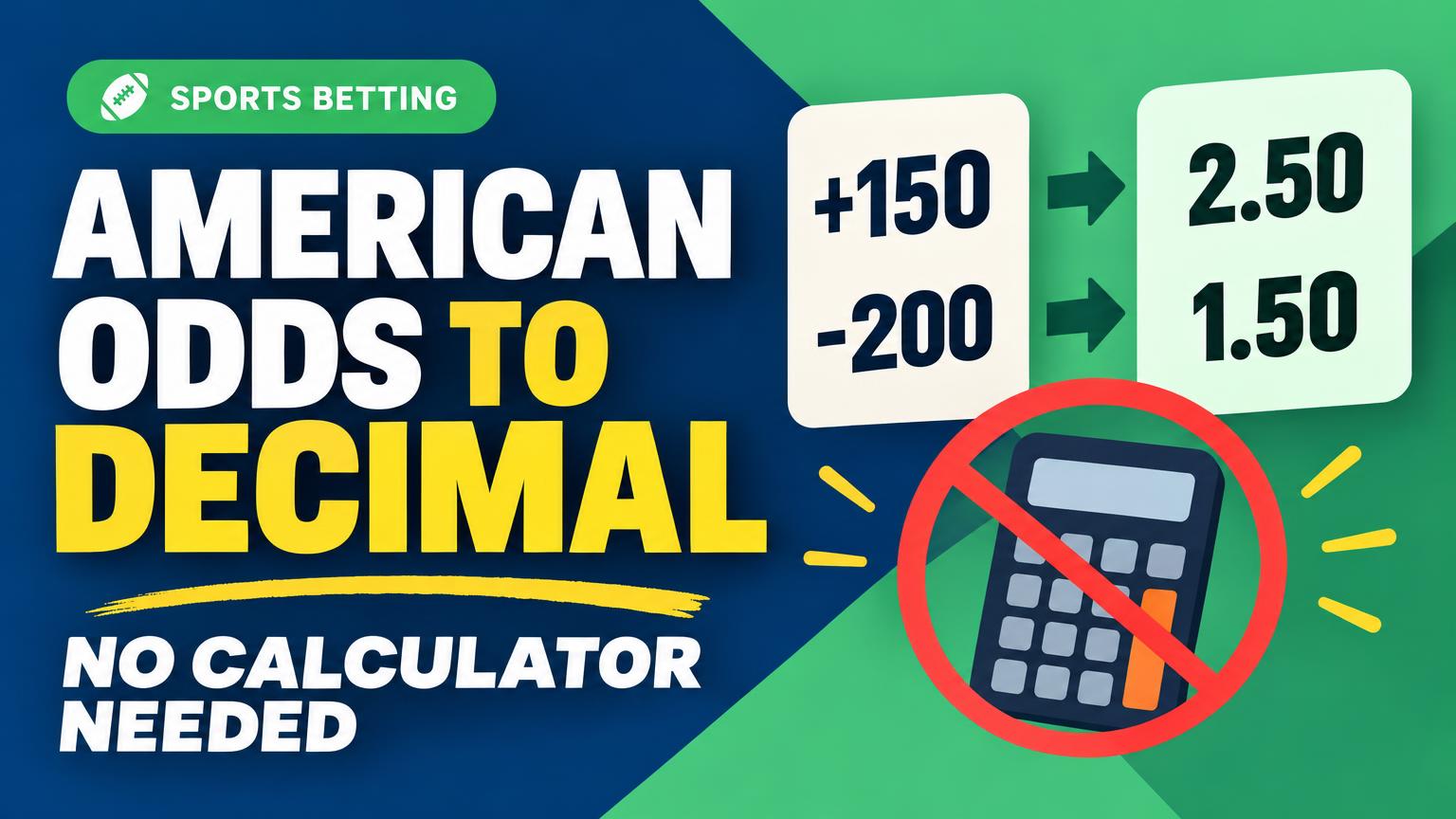
- Positive odds: Divide the number by 100, then add 1. At +150, the decimal odds are
150 ÷ 100 + 1 = 2.50. - Negative odds: Divide 100 by the number without its minus sign, then add 1. At −150, the calculation is
100 ÷ 150 + 1, or about 1.67.
The minus sign is ignored only after selecting the negative-odds formula. Treating −150 like +150 would produce 2.50 instead of about 1.67—a substantial difference. When working by hand, 100 ÷ 150 can be reduced to 2 ÷ 3, which is roughly 0.67.
Top Crypto Sportsbooks for November 2026
Vave Crypto Sportsbook
MyStake Sports
Sportsbet.io
LuckyBlock Sports
MegaDice Sports
TurboWins Sports
Cosmobet Sports
BetUS
BetNow
MyBookie
Rolletto Sports
Velobet Crypto Daily Deposit Offer
Velobet Crypto First Deposit Offer
Xbet
Both formulas end in +1 because decimal odds include the original stake in the total return. For example, a 10-unit stake at +150 produces 15 units of profit and returns 25 units in total. Dividing that total by the 10-unit stake gives decimal odds of 2.50.
Convert positive odds by moving the decimal point
- Start with the number after the plus sign
For +150, use 150. Positive American odds express the profit relative to a stake of 100; decimal odds express the total payout, including that stake.
- Divide by 100
Move the decimal point two places left: 150 becomes 1.50. This is the profit portion of the decimal figure.
- Add 1 for the returned stake
Add 1.00 to 1.50 to get 2.50, usually written as 2.5. The added 1 is not extra profit; it represents the original stake included in the total payout.
- Check with +100
Moving the decimal point turns 100 into 1.00. Adding the stake portion gives 2.00, or 2.0: one stake-sized unit of profit plus the returned stake.
Convert negative odds using the number after the minus sign
- Keep the sign in view, but leave it out of the division
The minus sign identifies the negative-odds formula: 100 ÷ the number shown, then + 1. For −200, the divisor is 200, not −200. The sign selects the method; it does not make the decimal result negative.
- Find the fraction for −200
Start with 100 ÷ 200. Since 100 is half of 200, the answer is 0.5. Adding 1 gives decimal odds of 1.5: the 0.5 represents the profit portion, while the added 1 represents the returned stake.
- Use a common factor for −125
For −125, work out 100 ÷ 125. Both numbers divide evenly by 25, turning the fraction into 4 ÷ 5, or 0.8. Add 1 to get 1.8. Reducing the fraction first makes this calculation manageable without long division.
- Check what happens when the sign changes
The same digits with a plus sign require a different calculation. For +125, divide 125 by 100 to get 1.25, then add 1 for decimal odds of 2.25. Thus −125 becomes 1.8, while +125 becomes 2.25. Checking the sign before dividing prevents the two from being mistaken for the same price.
Simplify negative odds before dividing
For negative odds, the decimal conversion is 1 + (100 ÷ the number after the minus sign). The division is easier to do by hand when the fraction is reduced first. Canceling a common factor changes the numbers, but not the value of the fraction.
Take −125. Its profit portion is 100/125. Both numbers divide by 25, so the fraction becomes 4/5. Four fifths is 0.8: five goes into 40 eight times, placing the 8 in the tenths position. Add the returned stake of 1, and −125 converts to 1.8.
−110 takes one more step. The profit portion is 100/110, which reduces to 10/11 after dividing both numbers by 10. Since 10 is smaller than 11, the answer begins 0.. Long division shows what happens next:
- Append a zero: 11 goes into 100 nine times, leaving a remainder of 1. The first digit is 9.
- Append another zero to that remainder: 11 goes into 10 zero times. The second digit is 0.
- Append one more zero: the division is back to 100 ÷ 11. The same 9, 0 pattern continues.
That makes 10/11 equal to 0.909090…. The digits repeat because the remainder returns to an earlier value rather than reaching zero. Adding 1 gives 1.909090…, commonly written as approximately 1.91.
The order matters: divide first, add 1, then round to the number of decimal places needed. For example, treating 10/11 as 0.9 too early would produce 1.9, hiding the hundredths digit. Keeping a few repeating digits until the final step makes the two-decimal result clear.
Since 10/11 is just under 1, the decimal result must be just under 2. That makes 1.91 plausible; 2.1 would signal that the fraction or the added 1 went astray.
Check whether the decimal odds make sense
A quick range check can catch a slip before the arithmetic is finished. Decimal odds always exceed 1 because they include the returned stake as well as any profit. If the result is 0.50 or 0.91, the final +1 was probably left out.
The sign of the American odds narrows the check further:
- Positive odds convert to 2.00 or higher. For example, +150 becomes 1 + 150/100 = 2.50. A result of 1.50 suggests that the profit portion was calculated but the stake was not added back.
- Negative odds normally convert to a number between 1 and 2. For example, −200 becomes 1 + 100/200 = 1.50. A result of 3.00 suggests the division was reversed: 200/100 instead of 100/200.
The numbers also give a rough direction check. As positive odds rise, their decimal equivalents rise: +200 becomes 3.00. As the number after a minus sign grows, the decimal equivalent moves closer to 1: −400 becomes 1.25, compared with 1.50 for −200. These checks do not replace the calculation, but they make an unlikely answer easier to spot.
Keep the two formulas together
Positive odds: decimal = 1 + (odds ÷ 100). Negative odds: decimal = 1 + (100 ÷ number after the minus sign). Both formulas include the returned stake. A quick check with familiar lines helps catch a misplaced sign: +100 becomes 2.00, while −200 becomes 1.50. For −110, the repeating fraction rounds to about 1.91.
Once those results look familiar, converted figures can be read on the same decimal scale when comparing lines. The decimal number describes total return per unit staked, not profit alone. For what that figure means with a particular stake, see the separate guide to calculating a bet’s potential return.
Top Crypto Sportsbooks for November 2026
Vave Crypto Sportsbook
MyStake Sports
Sportsbet.io
LuckyBlock Sports
MegaDice Sports
TurboWins Sports
Cosmobet Sports
BetUS
BetNow
MyBookie
Rolletto Sports
Velobet Crypto Daily Deposit Offer
Velobet Crypto First Deposit Offer